Planner › Blogs › Signal Plan vs Competitors
Why IT Pros Are Ditching Enterprise Bloatware for Browser-Based Wi-Fi Planners
Published by Signal Plan Engineering Team · 7 min read
If you are a Managed Service Provider (MSP) or an independent low-voltage contractor, you know the frustration: a client asks for a quick Wi-Fi coverage quote for a 5,000 sq ft office, and you are immediately stuck choosing between extremes. You either load up a sluggish, multi-thousand-dollar enterprise software suite, or you try to guess the access point (AP) count using blind intuition.
The network planning industry has historically trapped IT professionals behind massive paywalls or proprietary ecosystems. Today, we are breaking down why modern network engineers are abandoning these legacy systems in favor of frictionless, browser-based predictive planners.
The Hidden Cost of "Enterprise" Friction
Time is the most expensive metric for any IT business. Traditional desktop suites create immense psychological and operational friction before you even drop your first AP on a map.
- Enterprise SaaS (Ekahau, Hamina): These tools are the gold standards for massive corporate compliance, but they charge thousands of dollars annually or require specialized hardware surveys. If you are bidding on SMB offices or mid-sized hospitality venues, paying enterprise SaaS fees obliterates your project margins.
- Legacy Desktop Apps (NetSpot, Acrylic): These require heavy local OS installations, constant updates, and upfront licenses. You cannot simply open a browser on a client's site, upload a floor plan, and start quoting immediately.
The Vendor Lock-In Trap
To combat the high cost of desktop software, hardware manufacturers released their own free cloud planners. While highly capable, tools like the Ubiquiti UniFi Design Center and Cambium Wi-Fi Designer suffer from a fatal flaw: they strictly restrict your layouts to their proprietary hardware.
If a client wants to compare a deployment using Cisco Meraki MR44s against budget-friendly TP-Link Omada EAP670s, vendor-locked tools leave you stranded. True engineering requires objective, vendor-agnostic data.
The Psychological Advantage of Frictionless Utility
This is where Signal Plan completely shifts the paradigm. Built entirely on client-side HTML and JavaScript, it bypasses backend server lag and eliminates the login wall.
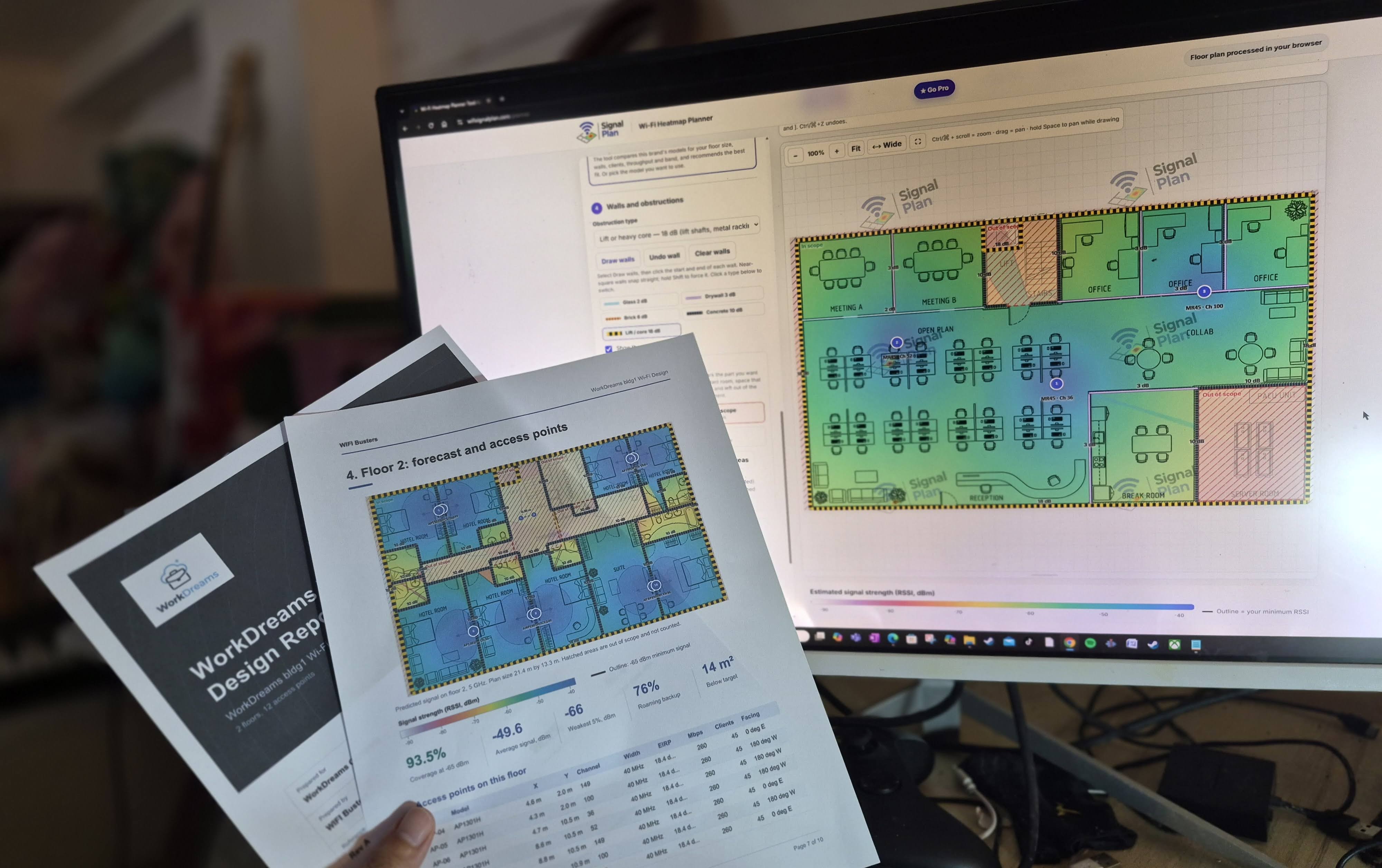
- Zero Latency: The moment you draw a concrete lift core or a drywall partition, the RF attenuation is calculated instantly in your browser. No waiting on remote servers.
- Total Privacy: Because the heavy lifting happens locally on your machine, your client's proprietary floor plans never leave your computer.
- Universal Support: You gain instant access to a database of 21 brands, allowing you to quote Cisco, Aruba, Ruckus, and Ubiquiti on the exact same canvas.
Wi-Fi Planner Comparison Matrix
| Feature | Signal Plan | Ekahau / Hamina | Vendor Planners |
|---|---|---|---|
| Software Format | Browser-based (No install) | Heavy Desktop / SaaS | Cloud-based |
| Brand Database | Vendor-Agnostic (21 Brands) | Vendor-Agnostic | Locked to single vendor |
| Base Cost | Free ($9/mo for Pro) | $1,500+ / Year | Free |
Frequently Asked Questions
How does Signal Plan compare to Ekahau and Hamina?
Signal Plan is a lightweight, browser-based alternative to heavy enterprise suites. While enterprise tools charge thousands of dollars annually for physical hardware integrations, Signal Plan runs entirely client-side for predictive planning, with professional HD exports available for just $6.
Is Signal Plan better than vendor-locked tools like Cambium Designer?
Yes, because it prevents vendor lock-in. Signal Plan allows network engineers to objectively compare access points from multiple different brands on the exact same floor plan, rather than restricting designs to a single hardware manufacturer.
Why Going "Pro" Pays for Itself on the First Quote
You can use Signal Plan to accurately model wall loss and AP placement completely for free. But when it is time to actually win a client bid, presentation is everything.
Sending a client a highly polished, watermark-free HD PDF report establishes immediate professional authority. Instead of pleading with procurement for a massive software license, independent contractors and MSPs can instantly expense a $6 single HD export straight to the client project quote.
For engineers running multiple bids per month, the $9/month or $59/year Pro subscription is a no-brainer. It unlocks unlimited watermark-free exports, multi-floor planning, and the ability to stamp your own company logo on the final PDF. For less than the cost of a fast-food lunch, you secure a professional tool that helps you close five-figure networking contracts.