Planner › Blogs › BPO & Call Center Wi-Fi
Are BPOs and Call Centers Finally Ready for Wi-Fi?
Published by Signal Plan Engineering Team · 7 min read
For years, Business Process Outsourcing (BPO) companies and call centers have relied exclusively on hardwired Ethernet connections. In an industry where a dropped Voice over IP (VoIP) call means lost revenue, physical cables provided a necessary safety net. But with the rapid advancement of wireless technology, many IT directors are asking: is it finally time to cut the cord?
The Benefits of Wired vs. Wireless
- Wired Reliability: Wired connections provide dedicated bandwidth to each agent and are completely unaffected by physical building materials. In contrast, wireless signals suffer attenuation from structural obstacles; for example, glass partitions cause about 2 dB of signal loss, standard drywall causes 3 dB, and dense concrete or lift cores can block 10 to 18 dB.
- Wireless Flexibility & Cost: Going wireless is significantly cheaper and faster to deploy because you only need one PoE (Power over Ethernet) port and cable drop per access point, rather than running a dedicated cable to every single desk.
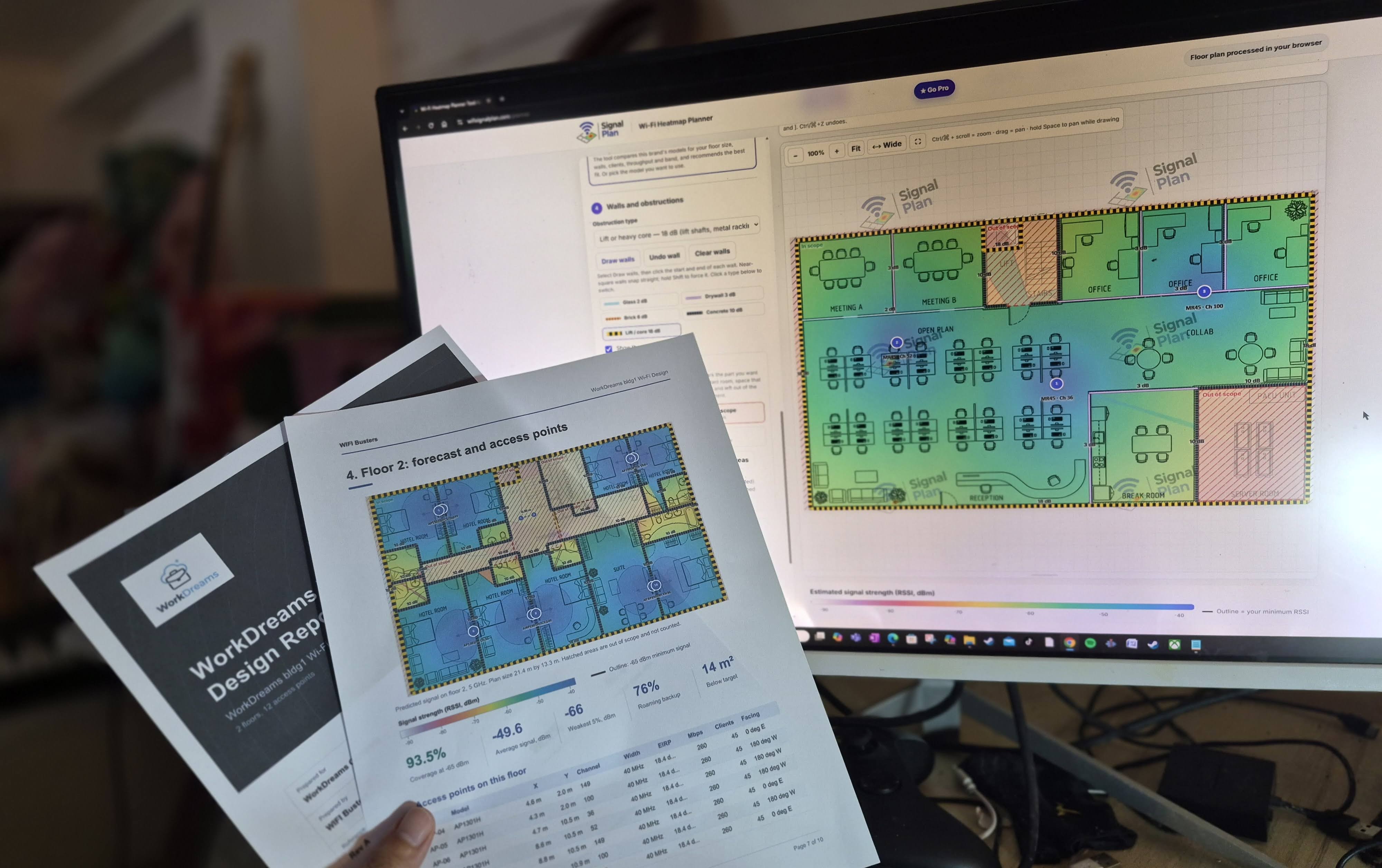
Wireless Upgrades: Then vs. Now
Older generations of Wi-Fi struggled with the "capacity" side of the equation.
- Historically, wireless networks bottlenecked when trying to handle high-density spaces packed with concurrent clients.
- Today, modern Wi-Fi generations determine capacity through faster processor speeds, more RAM, and advanced spatial streams like 2x2 or 4x4 MU-MIMO.
- These upgrades are essential for high-density spaces that must support hundreds of concurrent devices.
When to Go Wired Based on Purpose
If your facility has fixed agent workstations that exclusively handle mission-critical voice calls, a hardwired connection remains the gold standard for zero-latency communication. However, if your BPO is adopting agile seating, hybrid schedules, or collaborative huddle rooms, a robust Wi-Fi network is now fully capable of supporting those operations.
Deep Dive: Preferred Hardware Brands and Models
If you are transitioning a call center to wireless, you cannot use budget prosumer hardware. You must deploy mid-market or enterprise brands that are specifically built for high-density environments like hotels and call centers.
- Cisco Meraki: Models like the MR44 and MR55 are excellent cloud-managed enterprise options.
- Aruba Networking: Models like the AP-515 or the Ruckus R650 are also designed for these demanding, high-capacity environments.
- Flagship Ultra-High Density: For the ultimate call center deployment, the Aruba AP-555 is a flagship Wi-Fi 6 access point. It features dual 8x8 radios and is heavily favored by enterprise users who are designing large call centers or auditoriums.
← Back to the planner · Blogs · All brands · AP placement guide · RSSI guide · Pro · About · Methodology