
Planner › Blogs › Office Network Planning
The Modern Office Dilemma: Wired vs. Wireless Infrastructure
Published by Signal Plan Engineering Team · 6 min read
When moving into a new office space or upgrading an existing one, IT teams face a major budget decision: how much of the floor plan needs physical cabling? Because wireless infrastructure is significantly cheaper to install, modern offices are trending heavily toward Wi-Fi-first designs.
Why Wireless is Usually the Cheaper Route
The cost difference between wired and wireless networks largely comes down to labor and cabling.
- When planning a wireless network, you only have to provision one cable drop and one PoE port per access point.
- This removes the massive expense of dropping individual Ethernet cables into hundreds of cubicles or offices.
When to Choose Wired vs. Wireless
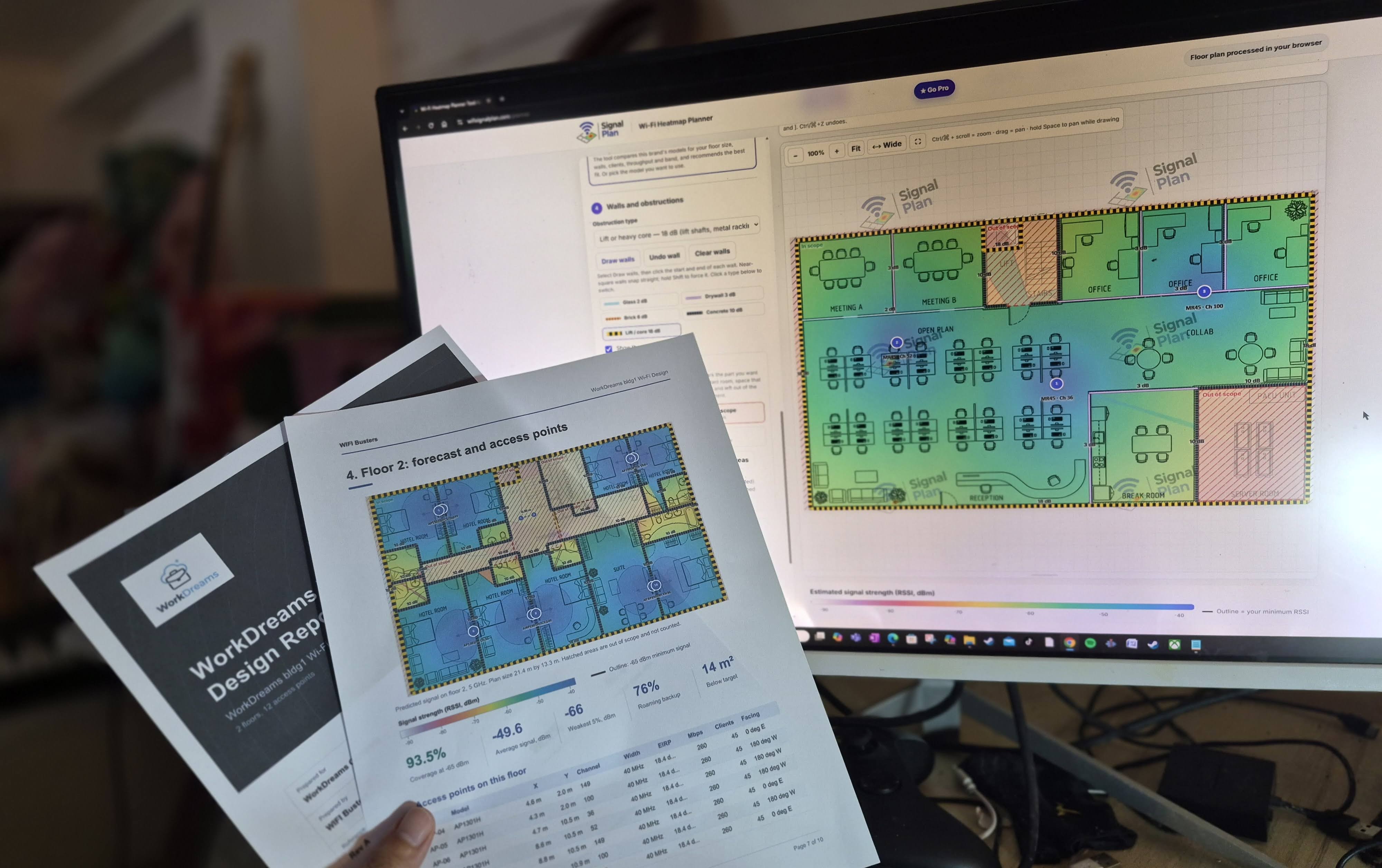
- Wired Environments: Save your Ethernet drops for server rooms, legacy desktop hardware, and heavy-bandwidth fixed workstations (like video editing bays). Server rooms are often enclosed in dense concrete walls which severely block Wi-Fi signals, making wired connections a physical necessity inside them.
- Wireless Environments: Wi-Fi is ideal for open-plan desks, meeting rooms, and collaborative spaces.
- Target Coverage: For standard corporate laptop connectivity, your IT team should aim for a target signal strength of -67 dBm. If your office heavily utilizes voice-over-Wi-Fi (VoWiFi) or 4K video streaming, plan for a stronger target of -60 to -65 dBm. For basic IoT devices and breakrooms, -70 dBm is sufficient.
Preferred Hardware for the Cost-Conscious Office
You don't always need to pay premium enterprise prices if your office environment doesn't have the extreme client density of a call center.
- Value Tier: For budget-conscious deployments and retail spaces, the TP-Link Omada tier (such as the EAP650 and EAP670) offers excellent value.
- Prosumer Tier: For medium offices and IT integrators wanting prosumer performance, Ubiquiti UniFi models like the U6-Pro and U7-Pro provide a great balance of cost and capability.
- Cost Breakdown: These budget and prosumer options typically range from $90 to $280, making them highly cost-effective compared to enterprise brands that can cost upwards of $1,000 per unit plus ongoing software licenses.
← Back to the planner · Blogs · All brands · AP placement guide · RSSI guide · Pro · About · Methodology